
Call Us
Email address
Address location
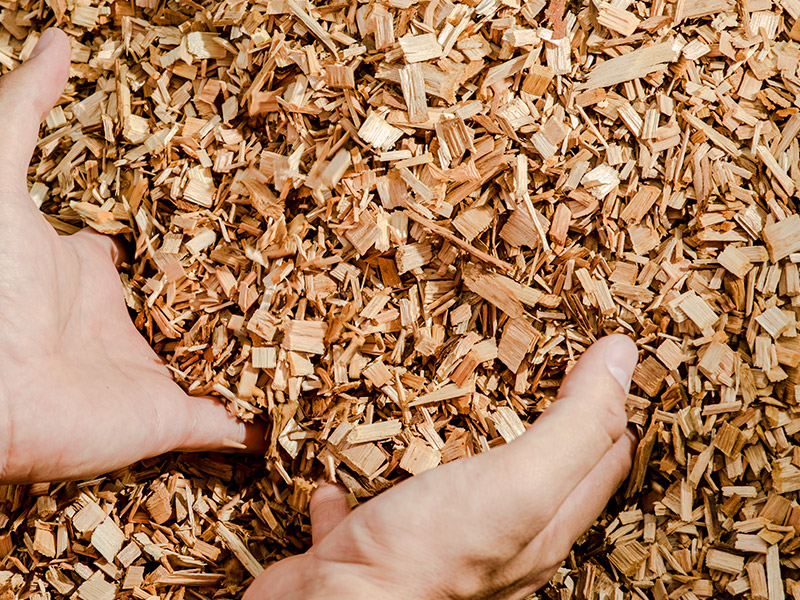
Wood chips are an economical and 100% green biofuel. They are obtained from waste generated by wood-processing industries such as sawmills, carpentries and furniture manufacturers, as well as from the agricultural sector. In a world increasingly focused on environmental sustainability and renewable energy, installing a machine for wood chip production can prove to be a winning choice.
In this article, we will look at how wood chips are produced, the machinery required and the various production stages involved.
Wood chips are one of the many products obtained from wood processing. They consist of wood shredded into fragments that can range in size from a few millimeters to several centimeters. In any case, the wood fragments must be uniform in size.
Wood chips are obtained through a mechanical process called “chipping”.
Due to their origin and characteristics, wood chips are considered a 100% ecological fuel, just like firewood, pellets and sawdust shavings.
Wood chips are produced using wood chippers, specific machines designed to process wood. In practice, the raw material (branches, trunks, wood waste, twigs, etc.) is fed into one side of the machine and returned from the opposite side properly shredded.
RP Engineering is a company specialized in the design, construction and installation of wood chippers and, more generally, industrial systems for the production and drying of wood chips, pellets, sawdust and biomass.
Wood chip production involves several stages.
First of all, in order to produce wood chips, it is necessary to obtain the required quantity of raw material. The raw material used for wood chips may consist of trunks, branches, waste from sawmills, carpentries and agricultural production.
The wood material is fed into the wood chipper, where it is shredded and reduced into many small fragments of uniform size in order to obtain a homogeneous and consistent product.
Once shredded, the wood chips are discharged into storage areas for drying. This process, which is necessary to obtain a product with low moisture content, takes a considerable amount of time and can last up to 24 months.
This stage is very important because dry wood chips with low moisture content provide better performance and produce very little residue.

Storage and extraction of wet raw materials

Material handling with screw, chain and belt conveyors

Refining of wet material

Drying of wet material with belt, drum or flash pipe dryers

Handling of raw materials with conveyors or pneumatically

Storage and extraction of dry raw materials in containment tanks or silos
Wood chips are a very economical material also because the raw material they come from is easy to source. Specifically, it consists of:
The most commonly used wood species for producing wood chips are conifers, chestnut, oak, poplar, hazel, beech and alder.
Depending on their origin, we can distinguish between hardwood and softwood chips.
As already explained, the machines used to produce wood chips are called “wood chippers”. There are different types available. The most common models are drum chippers and disc chippers. Depending on their application, these machines may vary in size and power.
We can therefore distinguish between industrial wood chippers, capable of processing entire trees, and small wood chippers for semi-professional or domestic use, capable of processing branches and twigs with diameters of only a few millimeters.
Generally speaking, we can identify three types of wood chippers.
Wood chips are a woody biomass and therefore represent a renewable energy source. Their main characteristics are:
Do you own a carpentry workshop, a furniture manufacturing company or a sawmill? Or do you work in gardening or agriculture and produce large quantities of waste every day, such as grass cuttings, branches and pruning residues? Turn your waste into a resource and consider purchasing a wood chipper. In this way, you can process your production waste to obtain wood chips for sale.
Today, woody biomass is a valuable resource, especially considering the goals of the 2030 Energy Transition, which increasingly promote the growth of renewable energy sources and foresee Italy’s phase-out from coal and fossil fuels in general by 2025.
Contact RP Engineering by filling out the dedicated contact form.
With more than 25 years of experience in this sector, we design, manufacture and install industrial systems for the drying and production of wood chips and other materials. We offer our customers customized solutions and a complete “turnkey” service. After installation, we remain available with dedicated support and assistance services.