RP Engineering

Wood Drying for Pellet Production: A Green Practice

Nowadays, environmental sustainability is a priority issue for many companies. In this context, wood recycling — understood as the recovery of waste materials from wood processing — represents a fundamental green practice for reducing environmental impact with a view toward a more sustainable future.

Artificial wood drying is, in itself, a sustainable practice. It reduces processing times and decreases both weight and bulk during the transportation of the final product.

RP Engineering, a company specialized in the design, construction, and installation of industrial systems for the drying and thermal treatment of sawdust, wood chips, biomass, and other materials of various kinds for pellet production, plays a key role in promoting wood recycling.

In this article, we will explain why wood drying is a green practice and how RP Engineering contributes to this vision through process optimization, the evolution of its machinery, and the improvement of operating performance.

Recovery of Waste from Sawmills and Carpentries

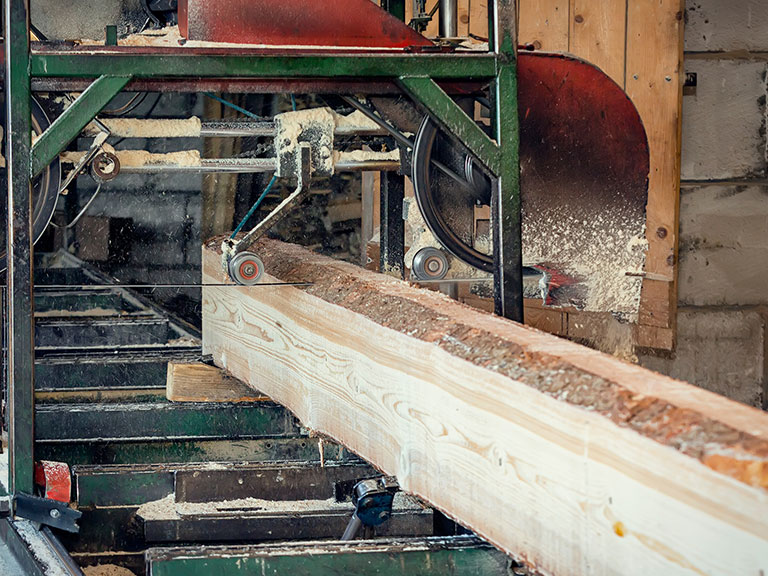
First of all, wood drying is a useful practice for recovering waste generated by wood processing. In fact, the cutting of timber produces sawdust and wood shavings: processing waste that can be used in various industrial sectors, for example in pellet production, a highly efficient and economical fuel considered a renewable energy source.

If not recycled and properly reused, the waste generated by sawmills, carpentries, and companies that process large quantities of timber becomes an ecological disposal problem.

Minimizing Environmental Impact

The wood industry brings with it significant negative environmental consequences. Deforestation, ecosystem degradation, and biodiversity loss are just some of these consequences.

In addition to negatively affecting wildlife habitats, forest destruction also has devastating effects on the climate, accelerating climate change, impacting water resources and air quality, and contributing significantly to greenhouse gas emissions.

In this context, wood drying in a controlled environment drastically reduces environmental impact. First of all, it leads to less deforestation and less waste. Furthermore, the artificial drying process guarantees greater production efficiency, benefiting the economic sustainability of businesses.

Moreover, the reuse of wood waste makes it possible to maximize the use of available resources, thereby preserving existing forests.

Recycling and Circular Economy

The good practice of wood recycling is an essential pillar in the transition toward a circular and sustainable economy.

In this regard, RP Engineering is actively committed to promoting the recycling of wood waste, thereby making a significant contribution to environmental conservation in order to offer a better world to future generations.

Sustainability Advantages of the Dryers Designed and Built by RP Engineering for Pellet Production

With over 25 years of experience and thousands of systems installed worldwide, RP Engineering offers clients small and medium-sized dryers characterized by a high degree of automation. Production is based on standard models that are customized to adapt to the client’s specific requirements.

RP Engineering’s green approach is also reflected within the company’s own operations. The continuous work carried out by the “Research and Development” department makes it possible to offer innovative and increasingly advanced systems and machinery capable of improving plant functionality and performance, achieving important results in terms of process optimization and energy recovery.

Low Temperature

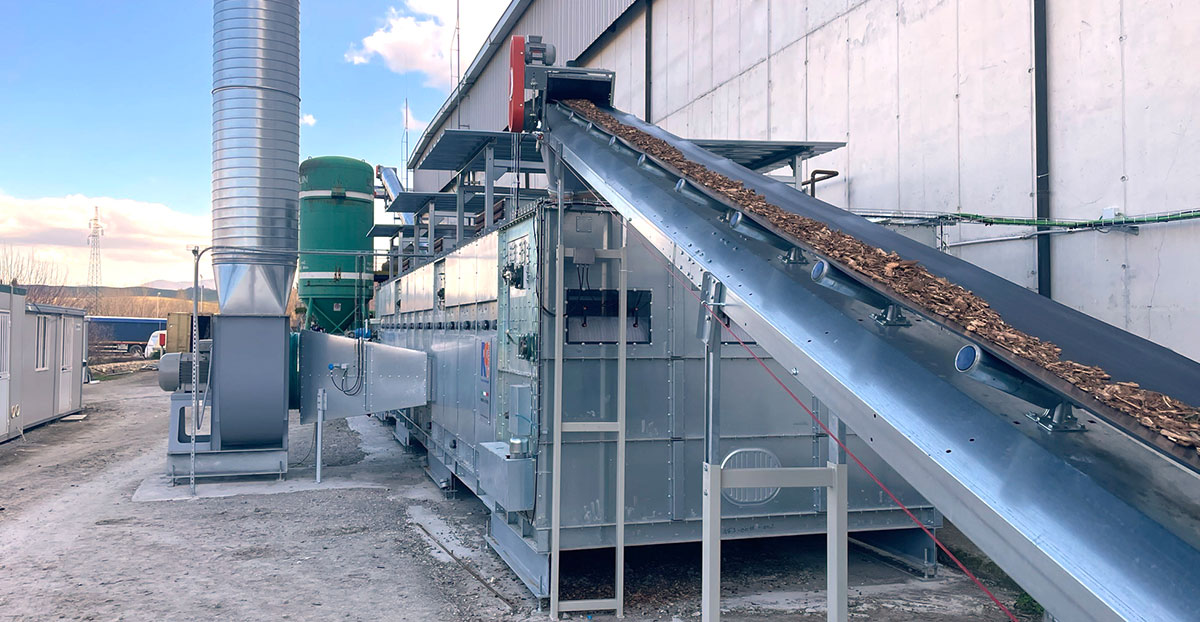
Belt dryers exploit low-temperature thermal energy, such as water, fumes, and steam at 60°C, originating from secondary processes.

Low Emissions

In addition to using very low temperatures, the dryers manufactured by RP Engineering produce low emissions (values below 20 mg/m3, in full compliance with the strictest European Community regulations regarding atmospheric emissions) thanks to a very tightly woven belt that filters dust particles.

Cycle Optimization

The dryers designed by RP Engineering are equipped with devices aimed at increasing the energy efficiency of the entire process.
They feature a high degree of mechanization and automation. They are equipped with sensors capable of detecting moisture levels as well as process management software. These features make it possible to achieve savings in terms of electrical and thermal energy while ensuring a very high drying quality standard and faster processing times.
The entire process can also be remotely controlled.

Quality of the Dried Product

Thanks to sophisticated features and low temperatures, the product maintains its characteristics almost completely unchanged.

Economic Advantages

Finally, from a purely economic point of view, the final dried product offers new commercial opportunities and possible applications, together with a significant reduction in storage and transportation costs.

Types of Dryers Designed and Built by RP Engineering for Pellet Production

RP Engineering designs and manufactures various types of dryers. The main ones are:

  • Belt dryers
  • Triple-pass rotary drum dryers
  • Flash dryers

All models can be integrated with various types of loading hoppers for feeding material into the dryers.

Customized Dryers: The RP Engineering Advantage

RP Engineering’s industrial drying systems are designed and built tailor-made for each client, paying the utmost attention to their specific production and energy requirements.
Continuous and in-depth dialogue with every client makes it possible to develop increasingly efficient technologies aimed at optimizing output and consumption while at the same time guaranteeing an excellent-quality dried product.

RP Engineering’s process is based on the following stages:

  • Analysis of the specific needs of each individual client
  • Development of customized projects based on standard base models
  • After-sales support with professional and personalized assistance

Want to Install an Industrial Drying System for Pellet Production? Choose RP Engineering

It is well known that our planet is currently experiencing an extremely fragile environmental balance. For this reason, it is essential that all companies make production choices capable of protecting the environment.

Thanks to a constant commitment to research, RP Engineering has developed an extremely accurate production process, perfected through the adoption of the most advanced technologies. With more than 25 years of experience in the sector, RP Engineering stands out for its ability to transform client requests into concrete and customized solutions, establishing itself as a worldwide industry leader and earning the trust of demanding customers.

If your company also embraces a green approach and you have decided to install an industrial drying system to recover wood waste by transforming it into pellets, contact RP Engineering by filling out the dedicated contact form. A team of professional technicians will be at your disposal to listen to your needs and propose the most suitable solutions.

In order to ensure all the quality and reliability that distinguish “Made in Italy” products, the entire production process takes place within RP Engineering’s facilities.

Read our latest news
Woody Biomass Drying Plants: Types and Operation
Woody Biomass Drying Plants: Types and Operation Woody biomass drying plants are machines designed and developed to dry wood-based materials using low-temperature thermal sources. These systems make...
Woody Biomass: What You Need to Know About This Important Renewable Energy Source
Woody Biomass: What You Need to Know About This Important Renewable Energy Source The dryers designed and manufactured by RP Engineering are suitable for drying a wide range of materials of various...
Storage System Design: Tanks and Silos
Storage System Design: Tanks and Silos RP Engineering specialises in the construction of industrial drying plants. In particular, the company focuses on the design, manufacturing, and installation of...
61